Engineering a Cleaner Way to Drive.
Our waste-to-energy process turns community trash into carbon negative, high-octane fuel — in three simple steps.
We take local trash that landfills won't touch — non-recyclable municipal solid waste that would otherwise sit in a landfill for decades. This waste becomes the feedstock for our process.
We break down that waste and rebuild it into pure gasoline using our precision-engineered carbon conversion process. No shortcuts, no compromises — just clean, efficient transformation.
You get Regular (87), Mid-grade (89), or Premium (93) octane fuel that's engineered to be carbon negative. Better for your engine, better for the planet, and better for your wallet.
A Refinery That Fits in a Shipping Container.
Our entire Fischer-Tropsch refinery is engineered to fit inside a standard intermodal container. That means we can deploy a fully operational fuel production unit anywhere a truck can reach — no massive infrastructure, no multi-year permitting nightmares, no billion-dollar refinery footprint.
Drop-In Deployment
Delivered by truck. Operational in days, not years.
Where the Waste Is
Site the unit next to landfills, municipalities, or fleet depots — turn local trash into local fuel.
Scale by Adding Units
Need more output? Add another container. Modular capacity, no redesign required.
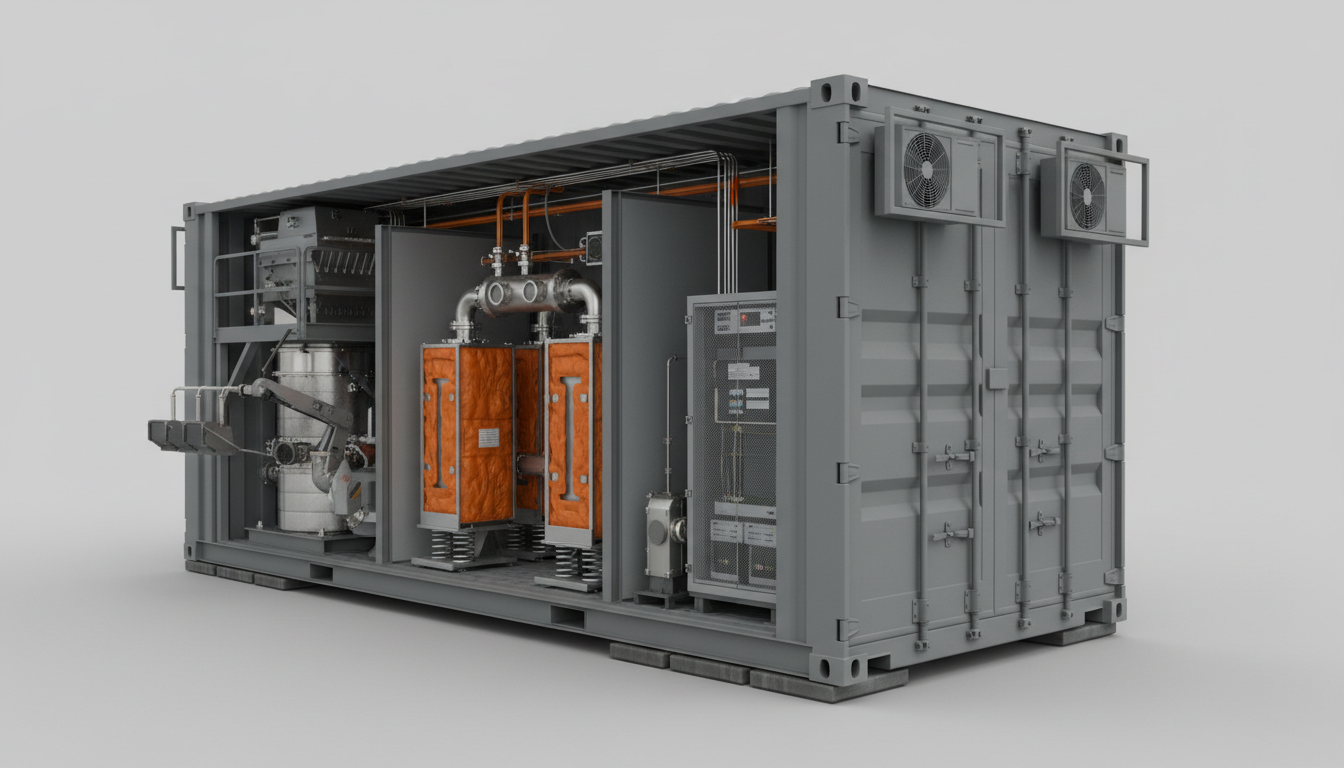
Rendering of eCOA's containerized Fischer-Tropsch refinery unit.
Daily Operational Performance.
Audited technical specifications for a single containerized eCOA Revision 26.0 modular system.
15 Tons
Daily MSW Processed
Municipal solid waste or tactical military refuse
2,250 Gal
Daily Gasoline Produced
Precision-engineered, drop-in fuel (87 / 89 / 93 octane)
250–500 kW
Gross Wattage Generated
Closed-loop CHP steam turbine; satisfies up to 92% of skid energy
~500 Gal
Potable Distilled Water
Ultra-pure byproduct of Fischer-Tropsch synthesis loop
~3 Tons
Vitrified Slag
Inert silicate glass — suitable for commercial sale as premium aggregate for concrete or road-base paving.
Daily Mass-Balance Breakdown
15 Tons
Raw Trash In
2,250 Gal
Fuel
500 Gal
Water
3 Tons
Glass Slag
Carbon Negative by Design
Our process is designed to remove more carbon from the environment than it puts out. It's not just green — it's better.